
Banking · Speculator and early student of price behavior
Jesse Livermore: The Tape Reader Who Won Fortunes and Lost Them
A teenage quotation-board worker learned to read prices. His fortunes showed both the power of observation and the limits of trading genius.
How did Jesse Livermore succeed?
Jesse Livermore succeeded in individual market campaigns by studying price movements, testing observations with small trades, and taking larger positions when trends confirmed his judgment. He learned through quotation-board work and speculation rather than college. However, repeated bankruptcies show that his spectacular wins did not produce durable financial security.
The story
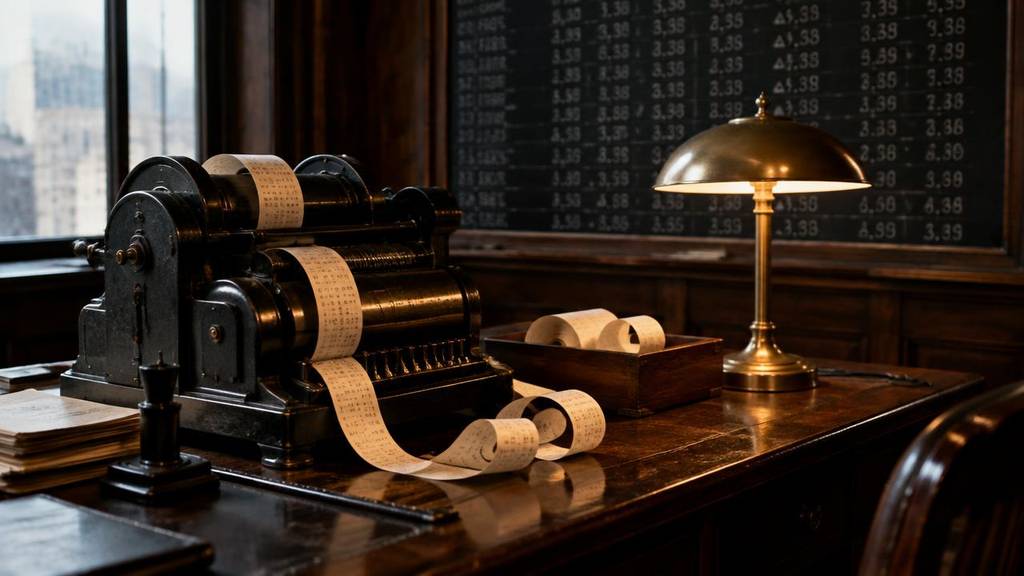
In 1891, fourteen-year-old Jesse Livermore began working in the Boston brokerage offices of Paine, Webber & Company. His job was to transfer prices from ticker reports onto a quotation board. Born in Massachusetts in 1877, he had left school for work rather than university. The board became his laboratory. While customers watched their holdings, he watched sequences: which movements continued, which stalled, and how apparently similar conditions produced different outcomes. It was an education in recorded behavior, conducted inside a noisy commercial workplace, before modern screens or widely standardized corporate disclosure existed.
Livermore tested his observations in bucket shops, establishments where customers wagered on price changes rather than necessarily buying the underlying securities. Their quoted prices and execution arrangements differed fundamentally from exchange trading. His early success in those rooms helped establish his reputation, but it also created a dangerous illusion of transferability. A method that worked against a local betting operator could fail when actual orders moved through a market. When he shifted toward legitimate brokers and New York trading, delays, transaction costs, and the difference between a displayed quotation and an executable price became expensive teachers.
The lesson arrived brutally during the market turmoil of May 1901. Livermore later described being undone by a ticker that lagged behind the market. A trader could appear profitable on the tape while the price available for an actual transaction had already moved away. This was not simply bad luck surrounding an otherwise perfect system. It exposed an operational weakness in his approach. His education therefore advanced through losses as well as observation: a forecast, an order, and a completed trade were separate events. Confusing them could destroy capital faster than an incorrect economic opinion.
Livermore became famous for bearish positioning around the Panic of 1907 and the crash of 1929. Accounts commonly put his 1929 gains at roughly $100 million, although historical trading figures should be treated as reported estimates rather than audited modern performance statements. His reputation rested on recognizing major market direction and having the nerve to act against prevailing confidence. He also came to emphasize waiting, testing a position, and increasing exposure only when market action supported it. The compelling part of that method was the feedback loop: price behavior could contradict his thesis, and contradiction was supposed to matter.
The word supposed is essential. Livermore did not reliably preserve the fortunes his best campaigns produced. He suffered repeated financial reversals and filed for bankruptcy again in 1934. His life contradicts any profile that presents a handful of celebrated trades as evidence of uninterrupted mastery. Leverage, concentration, emotional strain, and departures from his own principles all belong in the account. So does the historical environment: markets were less transparent, manipulation was common, and trading practices differed from today's regulated venues. Admiring his observational skill does not require recommending his exposure or romanticizing the consequences of failure.
Edwin Lefèvre's 1923 book Reminiscences of a Stock Operator drew heavily on Livermore's experiences through a fictionalized narrator. Livermore published How to Trade in Stocks in 1940, the year he died by suicide. Those books helped carry his ideas into later generations, but literary influence is not the same thing as a dependable investment record. His most useful legacy is a pair of competing truths: disciplined observation can uncover opportunities without a formal credential, and intelligence cannot substitute for capital preservation. A sound modern study of Livermore begins with his losses beside his triumphs, not hidden behind them.
The Cheat Code: shortcuts that worked
1. Cheat Code: Keep the Quotation-Board Notebook
Record a prediction before observing the outcome. Livermore's early advantage came from repeated attention to price sequences, not from retroactively explaining whichever move happened.
2. Cheat Code: Separate the Tape From the Fill
His exchange losses exposed execution risk. Track the difference between a visible price and an achievable transaction, including spreads, delays, and slippage.
3. Cheat Code: Make Confirmation Earn More Capital
Study his principle of testing a thesis before expanding exposure. In a simulation, require predefined evidence before increasing a position rather than rewarding confidence alone.
4. Cheat Code: Audit the Bankruptcy Years
Read 1934 alongside 1929. Evaluate drawdowns, leverage, and survival across a full career instead of selecting the most flattering market campaign.
Your plan to do the same
- Read Reminiscences of a Stock Operator while distinguishing its fictionalized narration from documented biography.
- Choose one liquid market and record timestamped observations without risking money.
- Write a testable entry thesis, invalidation condition, and maximum simulated loss for each idea.
- Measure realistic execution costs instead of assuming every displayed quotation is available.
- Compare trend-following results with a passive benchmark over multiple market conditions.
- Review failed trades and portfolio drawdowns before considering whether the method deserves any real capital.
Frequently asked questions
Did Jesse Livermore have a college education?
Livermore did not attend college. He entered brokerage work as a teenager and learned by posting quotations, observing price behavior, and speculating. That practical education developed considerable market skill, but his repeated reversals demonstrate that experience alone does not guarantee disciplined risk management or a financially secure career.
How much did Jesse Livermore make in 1929?
Historical accounts frequently credit Livermore with approximately $100 million in profits from bearish positioning around the 1929 crash. The figure is a widely repeated estimate, not a modern audited return series. It should also be considered alongside subsequent losses and his 1934 bankruptcy, rather than treated as permanent wealth.
Is Reminiscences of a Stock Operator Jesse Livermore's autobiography?
No. Edwin Lefèvre wrote the 1923 book using a fictionalized central character whose experiences closely reflected Livermore's career. It is influential financial literature, but not a literal autobiography or verified transaction ledger. Livermore's own book, How to Trade in Stocks, appeared in 1940 and presented his trading ideas directly.