Entrepreneurship · Self-taught maker, former MythBusters co-host, and Tested educator
Adam Savage Turned Making Into a Way of Thinking
The finished prop is only part of the lesson. The more useful story is how the measurements, mistakes, and revisions produced it.
How did Adam Savage succeed?
Adam Savage succeeded by building practical skills across modelmaking, props, special effects, and repeated personal projects rather than pursuing a formal maker qualification. Professional workshops sharpened his abilities; MythBusters amplified his curiosity. Through Tested, he made planning, mistakes, tool choices, and iterative problem-solving visible parts of instruction.
The story
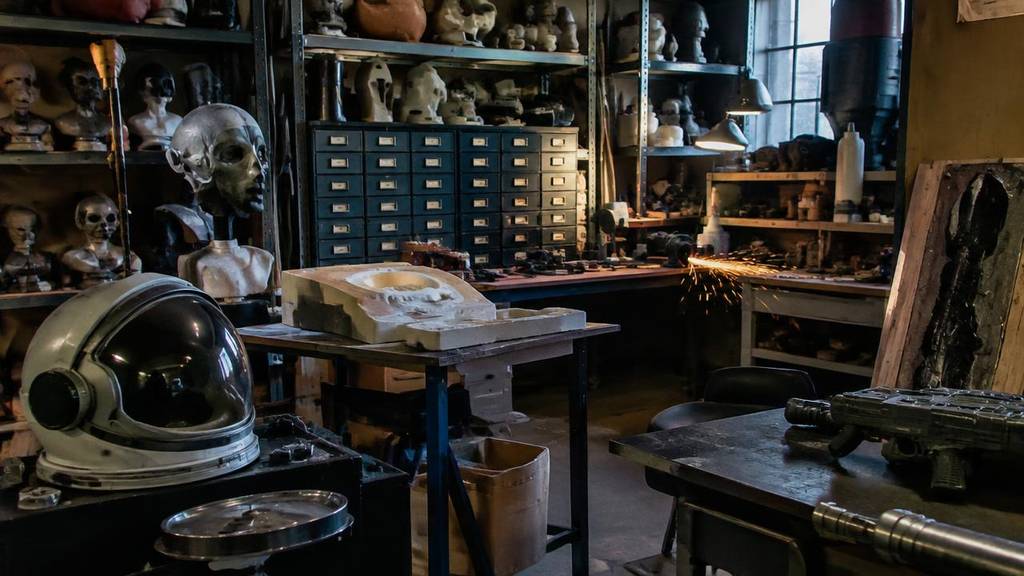
A build on Adam Savage's workbench often begins with a reference image, a rough measurement, or an object he wants to understand by making it. The appeal is not simply watching an expert produce a polished result. It is watching decisions become physical: a template becomes a cut, a cut reveals an error, and the error changes the plan. That process has made Savage a prominent guide for people learning outside formal programs. He shows making as a sequence of solvable problems rather than a performance in which skilled hands somehow avoid uncertainty altogether.
Born in New York City on July 15, 1967, Savage grew up in a creative household. His father, Whitney Lee Savage, was an artist and animator. As a young person, Adam experimented with animation, built objects, and worked as a child actor. His eventual technical education was not a single degree program. It accumulated through curiosity, jobs, collaborators, and repeated practice. That does not mean he developed in isolation. Professional shops and experienced colleagues were important teachers. The distinction is between an education assembled around actual projects and a formal credential that precedes entry into the field.
Savage worked across fabrication and entertainment, eventually building models and working in visual effects for films including Star Wars: Episode II—Attack of the Clones. Such environments demanded more than enthusiasm. A model needed to meet a brief, hold its shape, photograph correctly, and be completed on schedule. Materials and finishes had to serve the shot rather than an abstract ideal of craftsmanship. This supplied a practical discipline that later viewers might miss beneath his exuberance. The willingness to experiment was supported by professional habits of measurement, reference gathering, fabrication, and solving problems under constraints.
MythBusters premiered on Discovery in 2003, pairing Savage with Jamie Hyneman. The program turned claims from popular culture into build-and-test problems. Its original run ended in 2016, after years of experiments involving machines, crashes, projectiles, and other elaborate setups. Television entertainment and formal science are not identical, but the show made an important reasoning habit visible: a plausible story needs a test, and the test needs conditions that can be inspected. Building the apparatus was often as instructive as the final result. Viewers could see why a claim resisted a quick yes-or-no answer.
Savage's work with Tested developed a different pace and emphasis. Shop videos and One Day Builds could linger on organization, reference materials, hand tools, and the changing requirements of a project. A viewer could learn from a wrong measurement or a revised fastening method instead of seeing every difficulty removed in editing. His 2019 book, Every Tool's a Hammer, extended that approach into a broader account of creativity and work. The central resource was not possession of every expensive machine. It was an accumulating ability to choose a method, recognize a problem, and adapt without abandoning the project.
There are limits to imitation. MythBusters operated with professional crews and safety systems; its hazardous experiments are not appropriate home assignments. Even ordinary fabrication requires attention to eye protection, dust, ventilation, tool guarding, and material-specific risks. Savage's most transferable lesson is therefore not spectacle. It is the habit of making an idea testable at a safe scale. Build a rough version, learn what it reveals, and improve the next version. Over time, the object teaches you what the drawing could not, and the record of your decisions becomes a personal curriculum more useful than waiting to feel completely prepared.
The Cheat Code: shortcuts that worked
1. Cheat Code: Build the Question First
Identify the uncertainty blocking progress and make a small test for it. A joint sample or cardboard mock-up can answer more than another hour of speculation.
2. Cheat Code: Use the Reference as Evidence
Collect multiple views and establish known dimensions before fabricating a replica. Separate measurements supported by evidence from proportions you are only estimating.
3. Cheat Code: Keep the Failed Part
Label unsuccessful prototypes with what went wrong. They preserve information about fit, material behavior, or sequence that memory tends to simplify.
4. Cheat Code: Put Tools Where the Work Wants Them
Organize frequently used tools for visibility and easy retrieval. Shop layout should reduce interruptions to thinking, not merely look orderly in a photograph.
Your plan to do the same
- Choose a low-risk object or prop with a clearly defined purpose.
- Gather reference views and write down dimensions, materials, and unresolved questions.
- Make a paper or cardboard version to test scale and assembly.
- Practice unfamiliar cuts or joints on scrap with appropriate safety precautions.
- Build the next version while recording errors and changes to the plan.
- Evaluate function and finish separately, then select one improvement for another iteration.
Frequently asked questions
Did Adam Savage go to school for engineering?
Savage did not build his career through an engineering degree. His relevant skills developed through personal projects and professional work in modelmaking, fabrication, props, and visual effects. Experienced colleagues and production environments were important teachers, so self-taught describes a nontraditional pathway rather than learning without outside instruction.
What did Adam Savage do before MythBusters?
Before MythBusters premiered in 2003, Savage worked in several creative and technical roles, including modelmaking and visual effects. His film work included Star Wars: Episode II—Attack of the Clones. Those production jobs helped develop the fabrication, planning, and problem-solving skills he later brought to television experiments.
What can beginners learn from Adam Savage's Tested videos?
Beginners can study how Savage breaks a project into decisions, uses references, selects tools, and revises a plan when materials behave unexpectedly. The valuable lesson is the process, not copying every tool purchase. Choose low-risk projects and treat hazardous television experiments as professional productions, not home instructions.