
Entrepreneurship · Microsoft cofounder and software entrepreneur
Bill Gates Learned to Sell the Software, Not the Computer
Thousands of hours at a terminal came first. The company followed when a new kind of computer needed a language.
How did Bill Gates succeed?
Bill Gates succeeded through intensive programming practice, a complementary partnership with Paul Allen, and an early commitment to selling software independently of hardware. He left Harvard to build Microsoft, then used licensing agreements and relationships with computer manufacturers to distribute software across a rapidly expanding personal-computer market.
The story
Bill Gates encountered a computer terminal at Seattle's Lakeside School in 1968, when access to computing was still unusual for teenagers. The school and its supporters made that opportunity possible, and Gates used it intensely. With Paul Allen and other students, he explored programs, hunted for bugs, and sought additional machine time. Calling him self-taught should not erase this unusually favorable access. What distinguished his use of it was sustained practice. He learned by writing code, breaking assumptions, reading technical material, and working with peers who could challenge him—not by completing a university qualification in software entrepreneurship.
Gates and Allen also experimented with business before Microsoft. Their Traf-O-Data venture tried to process traffic-counter information for local authorities. It was not a major commercial success, but it forced them to confront the gap between building something technically interesting and delivering a product customers would adopt. Gates entered Harvard in 1973 while remaining deeply involved with computing. College supplied intellectual stimulation and talented contacts, but no settled plan to become a conventional graduate. The decisive opportunity arrived from outside the classroom, on the cover of a magazine advertising a small computer that needed useful software.
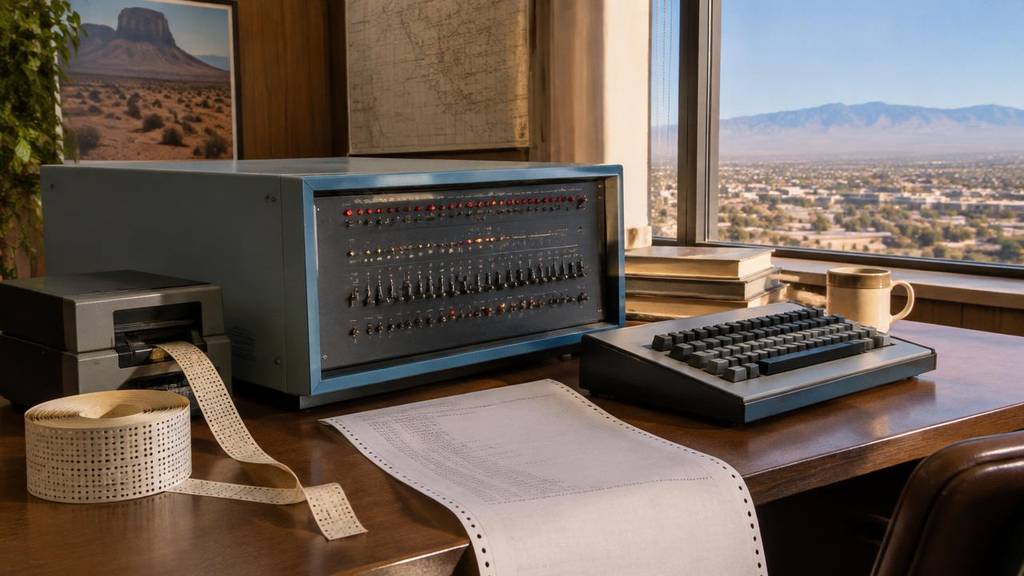
The January 1975 issue of Popular Electronics featured the Altair 8800. Allen recognized its significance, and he and Gates approached manufacturer MITS about providing a BASIC interpreter. They did not yet have a completed version running on an Altair. Working with help from Monte Davidoff on floating-point routines, they developed the software using other computing resources and an emulator. Allen traveled to demonstrate it. The successful demonstration established a commercial foothold in a market that barely existed. Gates left Harvard in 1975, and the partnership that became Microsoft began building a business around software for microcomputers.
The strategic choice was to treat software as a product with its own economic value. Early hobbyist culture often tolerated copying, while a software company needed paying customers to fund development. Gates's 1976 Open Letter to Hobbyists argued forcefully against unauthorized copying of Altair BASIC. The letter was controversial, but it clarified the company's position: code was not merely an accessory bundled with a machine. It could be licensed, maintained, and sold across a market. Microsoft expanded its language offerings and worked with different computer manufacturers rather than betting its future on producing a single proprietary hardware box.
The IBM PC opportunity in 1980 and 1981 made that model far more powerful. IBM needed an operating system. Microsoft obtained rights to a system developed at Seattle Computer Products, adapted it, and supplied the result to IBM as PC DOS. Crucially, Microsoft retained the ability to license its operating-system software to other manufacturers. As IBM-compatible computers proliferated, MS-DOS could travel with them. Gates did not personally invent every underlying component. The entrepreneurial achievement involved negotiation, adaptation, timing, and understanding how rights to a reusable software product could become more valuable as hardware suppliers multiplied.
Microsoft's position was not secured by one contract forever. It had to support developers, improve products, and navigate changing interfaces. Windows 1.0 arrived in 1985, but broader success came through later versions, including Windows 3.0 in 1990. Microsoft Office combined applications that became important to workplace computing. These products reinforced a platform business built around compatibility and widespread distribution. They also attracted scrutiny. In 1998, the United States filed its major antitrust case against Microsoft, challenging conduct associated with its market power. Commercial success and legally acceptable competition were not interchangeable measures of achievement.
Gates stepped down as Microsoft's chief executive in 2000 and later shifted much of his attention toward philanthropy. The startup lesson in his earlier career is more specific than 'drop out and code.' He had accumulated years of practice before leaving Harvard, had a highly capable partner, and entered a market at a rare moment of expansion. He then focused on ownership and licensing terms that allowed software to reach many machines. His advantage came from joining technical fluency to a distribution model—not from assuming that a degree was useless or that strong programming automatically creates a business.
The Cheat Code: shortcuts that worked
1. Cheat Code: Build a Practice Advantage Before the Leap
Gates had years of programming experience before leaving Harvard. Count completed, tested projects—not enthusiasm—when judging whether you are ready to rely on a technical skill.
2. Cheat Code: Watch New Hardware for Missing Software
The Altair created a need for a programming language. Look for a newly affordable device or platform whose users lack an essential tool you can credibly supply.
3. Cheat Code: Keep the Right to License Again
Microsoft's ability to license its operating system beyond IBM mattered enormously. Examine whether a contract sells one customer's use or unnecessarily gives away the entire reusable asset.
4. Cheat Code: Let Other Companies Carry the Product
Microsoft distributed through computer manufacturers. Find complementary businesses whose own offering becomes more useful when your software or service is included.
Your plan to do the same
- Choose one emerging platform and list the tasks its early users still perform manually or poorly.
- Complete a small working tool for one task and test it against three realistic examples.
- Find a collaborator who can review the code or sell the result, depending on your weaker capability.
- Approach one platform vendor or complementary business with a demonstration tailored to its customers.
- Draft licensing options that distinguish support, customization, exclusivity, and reusable intellectual property.
- Ship to one paying user, then document installation and compatibility so a second distribution partner can adopt it.
Frequently asked questions
Did Bill Gates graduate from Harvard?
Gates left Harvard in 1975 without completing his undergraduate degree so he could build the business that became Microsoft. Harvard awarded him an honorary degree in 2007. Before leaving, he already had years of programming experience, access to capable collaborators, and a concrete opportunity supplying software for the Altair.
Did Bill Gates write the first Microsoft software alone?
No. Gates and Paul Allen developed the Altair BASIC project together, with Monte Davidoff contributing floating-point routines. Gates was an important programmer, but Microsoft's beginning was collaborative. The initial achievement also involved demonstrating the software, negotiating with MITS, and turning working code into a supported commercial product.
Why was the IBM deal so important to Microsoft?
Supplying the IBM PC gave Microsoft a prominent customer and a place in a rapidly expanding market. The agreement also allowed Microsoft to license its operating-system software to other manufacturers. As compatible PCs spread, that retained licensing ability helped Microsoft distribute MS-DOS far beyond IBM's own machines.