
Design · Fashion designer and founder of Chanel
Coco Chanel Made Her Own Wardrobe a Design Argument
Her breakthrough was not simply a little black dress. It was a repeatable proposition: modern clothes could offer freedom without surrendering distinction.
How did Coco Chanel succeed?
Coco Chanel succeeded by translating practical clothing and her own pared-back style into a recognizable luxury proposition. Without formal fashion-school training, she developed sewing and millinery skills, secured financial backing, and expanded from hats into clothing and perfume. Jersey garments, simplified silhouettes, and consistent branding helped distinguish her business.
The story
Gabrielle Chanel was born in Saumur, France, in 1883, far from the social world her name would eventually signify. After her mother's death, she spent formative years in institutional care at Aubazine. Biographical accounts connect her early sewing knowledge with that convent environment, although Chanel later embroidered and obscured parts of her own history. She subsequently worked as a seamstress and sang in cafés, acquiring the nickname Coco. There was no fashion-school qualification behind her entry into design. There were practical skills, observation, ambition, and an increasingly sharp understanding of clothing as a means of changing one's social position.
Her early business also depended on money and access supplied by wealthy men, particularly Arthur 'Boy' Capel. Chanel opened a millinery shop at 21 rue Cambon in Paris in 1910, followed by a Deauville boutique in 1913 and a couture establishment in Biarritz in 1915. These were strategic locations, not interchangeable storefronts. Resort customers had reasons to want clothes suited to walking, leisure, and informal social life. Chanel's relatively restrained hats and sportswear offered an alternative to heavily embellished fashion. Her own appearance helped demonstrate the proposition: she sold not only individual garments but a legible way of inhabiting them.
During the First World War, Chanel helped establish jersey as a material for fashionable women's clothing. Its associations with underwear and sport made it an unlikely vehicle for luxury, yet its softness and flexibility supported the ease she wanted. This was not the single-handed invention of comfortable dress; broader social changes and other designers mattered. Her particular achievement was to make understatement commercially persuasive. Cardigans, straightforward skirts, and relaxed ensembles offered customers a coherent vocabulary. Instead of requiring every garment to announce wealth through elaborate decoration, the wardrobe could signal distinction through proportion, consistency, and the confidence of the wearer.
In 1921, Chanel launched Chanel No. 5, developed with perfumer Ernest Beaux. The product extended the house beyond garments and made its name portable in another form. A 1924 business arrangement with the Wertheimer family helped scale the perfume enterprise, though it also generated a long struggle over ownership and control. In 1926, American Vogue featured a simple black Chanel dress, comparing its broad potential to the Ford automobile. The image became central to the little-black-dress story. Black clothing already existed, of course; Chanel's impact lay in helping frame a spare black dress as a modern, versatile fashion proposition.
A complete account cannot treat the Second World War as an inconvenient blank. Chanel closed her couture business in 1939 while the perfume business continued. During the German occupation of Paris, she had a relationship with German officer Hans Günther von Dincklage. Archival research has documented her involvement with German intelligence, and she attempted to use antisemitic occupation laws to wrest control of the perfume business from the Jewish Wertheimers. These actions are part of her biography, not peripheral gossip. Commercial influence and design skill do not erase collaboration, opportunism, or the people endangered by the political machinery she sought to exploit.
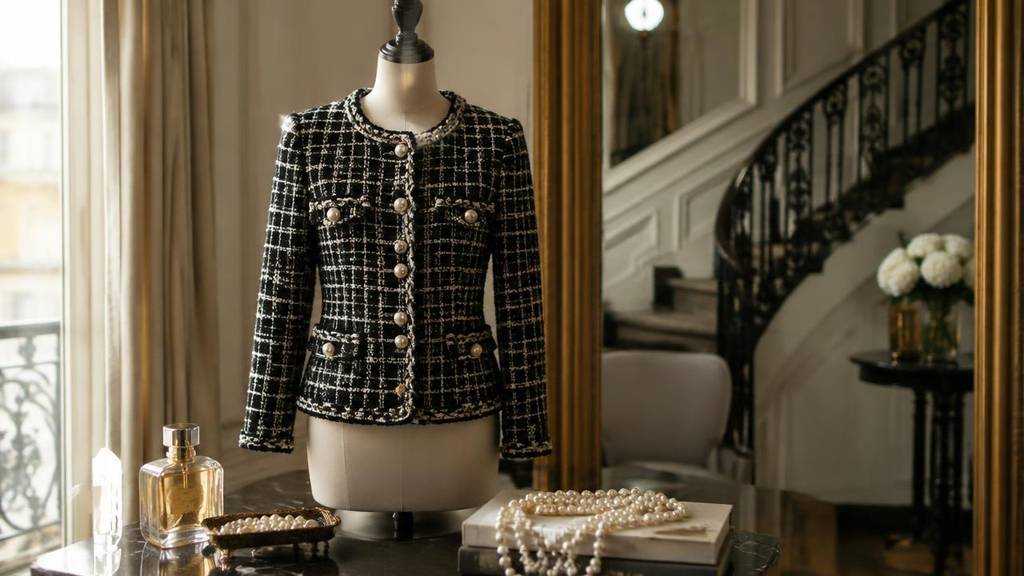
Chanel reopened her couture house in 1954, when she was seventy. Her return initially faced resistance in France, but American buyers and customers helped establish its success. The supple suit, contrasting trim, costume jewelry, and quilted handbag formed a durable system of recognizable elements; the 2.55 bag arrived in February 1955. She died in 1971 with an unusually coherent design identity attached to her name. Her career demonstrates how practical experimentation, a personal uniform, financial relationships, and product extension can reinforce one another. It also demands a distinction between studying an effective design method and presenting its author as an uncomplicated moral exemplar.
The Cheat Code: shortcuts that worked
1. Cheat Code: Test Luxury in an Unlikely Fabric
Examine how jersey's flexibility supported Chanel's proposition. Choose a material for its behavior before judging its social prestige.
2. Cheat Code: Wear the Design Thesis
Develop a personal working wardrobe that tests your ideas about movement, proportion, and repetition before presenting them to customers.
3. Cheat Code: Design for a Specific Social Setting
Use Deauville as a case study in matching clothes to a customer's actual activities rather than an abstract ideal of elegance.
4. Cheat Code: Build Recognizable Combinations
Study how trim, chains, quilting, and restrained silhouettes became a coordinated vocabulary rather than unrelated seasonal decorations.
Your plan to do the same
- Select one daily activity that existing formal clothing makes unnecessarily awkward.
- Make fabric samples comparing stretch, weight, drape, and recovery during that activity.
- Create three garments that share a silhouette but serve different occasions.
- Wear-test the pieces and document changes needed for sitting, reaching, and walking.
- Define two recurring visual details that connect the garments without adding excess ornament.
- Write a business history of your concept that clearly credits collaborators, capital, and material sources.
Frequently asked questions
Was Coco Chanel formally trained as a fashion designer?
Chanel did not attend a formal fashion-design school. She acquired sewing skills early, worked as a seamstress, and entered business through millinery before expanding into clothing. Her development combined practical experience with observation and commercial support. It would be misleading to describe her success as skill-free intuition.
Did Coco Chanel invent the little black dress?
No single designer invented black dresses. Chanel helped make a simple black dress an influential modern wardrobe staple, especially after American Vogue featured her design in 1926. Her contribution was a persuasive combination of simplicity, versatility, publicity, and brand identity rather than the first use of black clothing.
What did Coco Chanel do during World War II?
Chanel lived in occupied Paris and had a relationship with a German officer. Archival evidence documents involvement with German intelligence. She also sought to exploit antisemitic laws against the Wertheimers in a dispute over Chanel perfumes. These facts complicate her legacy and should accompany accounts of her design achievements.