
Design · Couturier and innovator of sculptural clothing
Cristóbal Balenciaga Learned Fashion from the Inside Out
Long before his surname became a global label, a tailor's apprentice learned enough about construction to change the silhouette itself.
How did Cristóbal Balenciaga succeed?
Cristóbal Balenciaga succeeded through deep practical mastery of cutting, fitting, sewing, and fabric behavior. Beginning with his seamstress mother and a tailoring apprenticeship, he built a Spanish business before opening in Paris in 1937. His technical control allowed him to invent new volumes rather than rely on surface decoration alone.
The story
Cristóbal Balenciaga was born in 1895 in Getaria, a fishing town in Spain's Basque Country. His mother worked as a seamstress, giving him early access to the intimate relationship between fabric, workmanship, and a customer's body. At twelve, he began a tailoring apprenticeship in nearby San Sebastián, a resort city with a demanding fashionable clientele. His route did not pass through a modern fashion-degree program, but it was far from untrained. He learned an exacting trade. Measurements, cutting lines, hand stitches, and fittings formed a practical education in which a plausible drawing counted for little if the finished garment failed.
In 1917, he established his first fashion business in San Sebastián. Later operations included houses in Madrid and Barcelona and businesses using the name Eisa, derived from his mother's surname. Spanish customers gave him years of experience before his international breakthrough. He studied the work of Paris couturiers, while his own background supplied another visual reservoir: religious dress, regional clothing, court portraiture, and the dramatic contrasts of Spanish painting. These references did not function as a fixed costume collection. They became material for reinterpretation by someone who understood how to turn an observed shape into an accurately cut, wearable object.
The Spanish Civil War disrupted that career. Balenciaga opened his Paris house at 10 avenue George V in 1937, entering the couture capital as an established practitioner rather than an inexperienced newcomer. His reputation grew quickly among customers who valued exceptional workmanship and a distinctive silhouette. Unlike a designer dependent entirely on a separate technical team to realize an image, he could cut, assemble, and sew garments himself. That ability did not eliminate the importance of the atelier. It gave him an unusually direct relationship with its work and a precise vocabulary for changing a design when the material resisted the original intention.
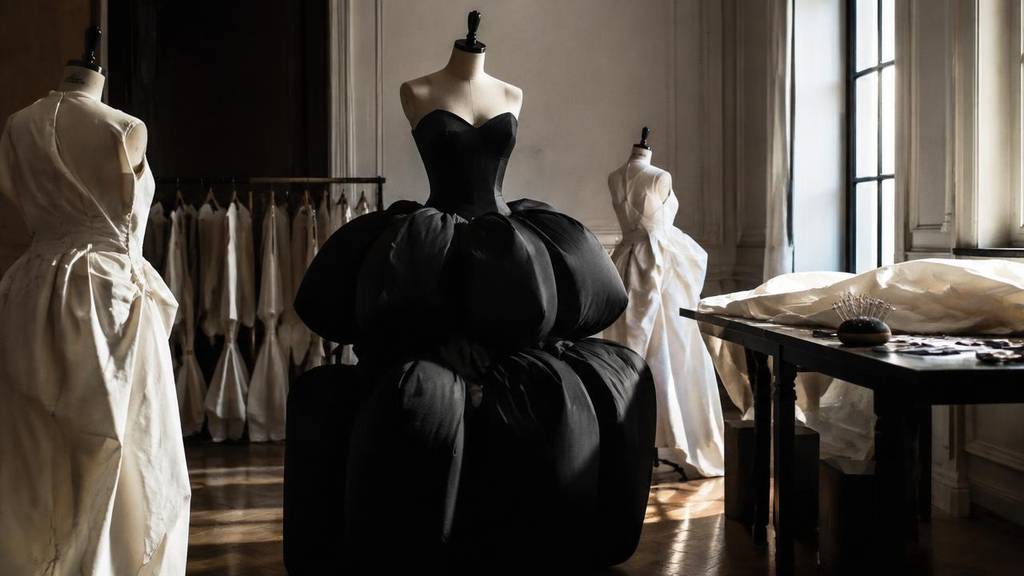
The radical phase of his postwar work came through successive adjustments to the relationship between clothing and body. The semi-fitted suit of 1951 allowed different degrees of definition at the front and back. The tunic line appeared in 1955, followed by the sack dress in 1957 and the baby-doll silhouette in 1958. These developments challenged the assumption that elegance required a tightly marked waist. Volume could hang, hover, or project away from the figure. The results were not shapeless accidents. They depended on calibrated proportions and construction that made a seemingly simple outline retain its intended balance during wear.
Fabric knowledge made those experiments possible. Balenciaga worked with the Swiss textile manufacturer Abraham in developing silk gazar, whose body supported architectural shapes without the same reliance on internal frameworks. His later eveningwear could make a garment look almost continuous, as though seams and labor had disappeared. That visual economy demanded more skill, not less. He was also protective of the conditions in which his work was seen, changing presentation timing to limit rapid copying. Publicity mattered, but he did not cultivate the same personal celebrity as some competitors. The atelier's output remained the primary argument for his authority.
Balenciaga closed his couture house in 1968 and died in 1972. The contemporary company bearing his name belongs to a later corporate and creative history, not an uninterrupted expression of his personal intentions. His original achievement lies in the garments and the methods that produced them. He demonstrates a particular route outside academic training: apprenticeship so thorough that it becomes a platform for invention. The lesson is not simply to perfect inherited technique and stop. It is to know construction well enough to identify which inherited rule can be changed—and to make the new shape convincing in actual fabric, on an actual person.
The Cheat Code: shortcuts that worked
1. Cheat Code: Let the Fabric Set the Terms
Handle and suspend a textile before sketching a silhouette. A design should exploit its behavior rather than demand that every fabric act alike.
2. Cheat Code: Fit the Front and Back Differently
Study the semi-fitted suit to see how one garment can combine definition with freedom instead of imposing the same tightness everywhere.
3. Cheat Code: Remove the Expected Waist
Explore a silhouette that does not depend on cinching. Use proportion and balance to create intention rather than substituting mere looseness.
4. Cheat Code: Learn Every Atelier Stage
Practice pattern cutting, assembly, fitting, and finishing so you can locate the actual cause when a garment fails.
Your plan to do the same
- Take supervised instruction in tailoring and complete a fitted basic garment.
- Create a sample library recording each fabric's weight, stiffness, drape, and response to pressing.
- Reconstruct a documented historical silhouette in inexpensive toile rather than copying a photograph superficially.
- Develop three waist-free variations with different balances of shoulder, hem, and back volume.
- Fit the same design while standing, sitting, and walking, marking every unintended collapse.
- Simplify the final construction only after the intended shape works reliably.
Frequently asked questions
Was Cristóbal Balenciaga self-taught?
Balenciaga did not attend a modern fashion-design degree program, but he received substantial practical training. His mother was a seamstress, and he began a tailoring apprenticeship at twelve. His career is better understood as apprenticeship-based mastery than as the work of someone who learned entirely without instruction.
Why was Cristóbal Balenciaga called a master?
His reputation rested on exceptional command of the entire garment-making process, including cutting, assembly, fitting, and hand sewing. That technical depth enabled silhouettes that changed the relationship between dress and body. Fellow couturiers admired his construction knowledge, not merely the elegance of his sketches or the prestige of his clientele.
Did Cristóbal Balenciaga create the sack dress?
Balenciaga introduced his influential sack dress in 1957, challenging the sharply defined waist dominant in much postwar fashion. Its apparent simplicity depended on controlled cut and proportion. The design belongs within his broader investigation of tunics, semi-fitted forms, and volumes that stood away from the body.