
Business · Ford Motor Company founder and manufacturing organizer
Henry Ford Learned Machines Before He Learned Mass Production
A farm boy's mechanical education became a manufacturing revolution—but the revolution depended on a team.
How did Henry Ford succeed?
Henry Ford succeeded by combining practical mechanical experience with a business commitment to affordable cars. After early failures, he and his teams developed the Model T, standardized production, and refined moving assembly methods. Lower unit costs supported lower prices and greater volume, while higher wages helped stabilize a demanding industrial workforce.
The story
Henry Ford's starting point was a Michigan farm, not an engineering college. Born in 1863 near Dearborn, he became fascinated by mechanical work and left home in 1879 for apprenticeships in Detroit machine shops. He later returned to farm work while continuing to repair and operate machinery. These experiences gave him direct acquaintance with engines, metalworking, and the frustration of unreliable equipment. He did not simply reject education. He pursued a different kind: repeated contact with machines whose performance could be tested rather than argued about.
In 1891, Ford joined the Edison Illuminating Company in Detroit and became chief engineer in 1893. The job provided income and access to a technically stimulating environment while he experimented with gasoline engines outside working hours. In June 1896, he completed the Quadricycle, a light vehicle on four bicycle wheels. It was a working demonstration, not yet a durable consumer business. Building something that moved established one kind of competence; making a car reliable, manufacturable, affordable, and commercially viable would require a much broader education.
The transition was uneven. The Detroit Automobile Company, organized in 1899, failed in 1901. Ford's involvement in the subsequent Henry Ford Company also ended before that enterprise became Cadillac. Racing helped him attract attention and financial backing, but it did not resolve every disagreement about what a car company should produce. Ford Motor Company was incorporated in June 1903 with a group of investors. Ford was neither a solitary inventor nor a man who succeeded on his first attempt. His early failures exposed the distance between technical ambition and a workable organization.
The Model T, introduced in 1908, supplied the product around which the organization could concentrate. It was designed for durability, straightforward operation, and the rough conditions drivers actually encountered. Ford and colleagues including Childe Harold Wills, Joseph Galamb, and Eugene Farkas contributed to its development. The commercial objective was ambitious: expand the market beyond affluent enthusiasts. That meant cost was not a final accounting detail. It became a design constraint linking materials, parts, factory layout, repairability, and the price a much larger population could realistically pay.
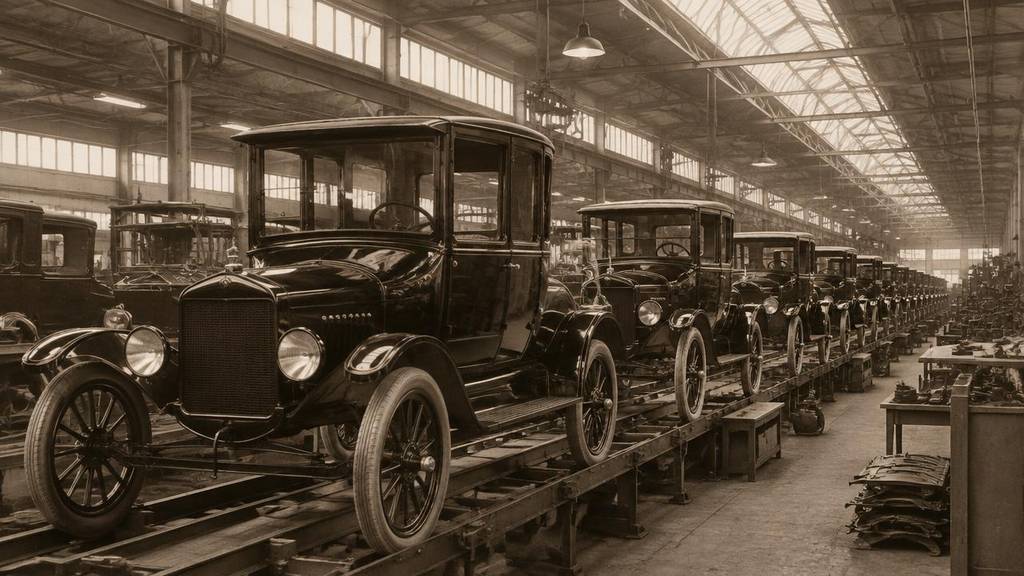
At Highland Park, Ford's production teams progressively reorganized work. In 1913, moving assembly methods began transforming automobile manufacture. Instead of workers repeatedly walking around a stationary vehicle, the work advanced through specialized tasks. As methods improved, assembly time for a Model T chassis fell from more than twelve hours to roughly ninety-three minutes. Ford did not invent every underlying technique or develop the system alone. The achievement was integration: interchangeable components, coordinated material flow, specialized machinery, and a workforce arranged around a deliberately simplified product.
Efficiency brought human costs. Repetitive work and demanding production rhythms contributed to severe employee turnover. In January 1914, Ford announced the famous five-dollar day alongside an eight-hour workday. The compensation plan initially included profit-sharing conditions and intrusive scrutiny of workers' private lives, so it should not be reduced to uncomplicated generosity. Nevertheless, better pay helped address an expensive staffing problem. Production volume climbed, prices fell, and more than fifteen million Model Ts were built before production ended in 1927. The factory's economics and its labor policies were inseparable.
Ford's strengths eventually hardened into limitations. His resistance to replacing the Model T allowed competitors to gain ground, and his public promotion of antisemitism remains an essential part of his record, not an incidental footnote. The useful business lesson requires neither hero worship nor imitation of his prejudice. He learned machinery through practice, then built an organization capable of learning production at scale. Affordability emerged from thousands of coordinated decisions, not a slogan. The accompanying warning is equally clear: a method that transforms one market can become a liability when its creator stops listening.
The Cheat Code: shortcuts that worked
1. Cheat Code: Design Backward from an Affordable Price
The Model T linked product choices to mass-market economics. Establish a realistic customer price, then examine which materials, features, and processes make it sustainable.
2. Cheat Code: Move the Work, Not the Worker
Highland Park reduced unnecessary movement through coordinated flow. Map every handoff and walking trip before assuming faster individual effort is the answer.
3. Cheat Code: Standardize Before Automating
Ford's production gains depended on repeatable components and tasks. Stabilize specifications first; machinery multiplies inconsistency as readily as it multiplies output.
4. Cheat Code: Price Turnover into Your Labor Model
The five-dollar day addressed a costly workforce problem. Compare better compensation with the full expense of recruiting, training, absences, and lost production.
Your plan to do the same
- Acquire practical repair or fabrication experience with the product category you want to enter.
- Build a functioning prototype and record where it fails under ordinary use.
- Choose one broad customer need instead of multiplying product variants.
- Break production into timed tasks and map movement between them.
- Test one flow improvement while measuring defects and worker strain.
- Revisit the product regularly so manufacturing success does not conceal changing customer demand.
Frequently asked questions
Did Henry Ford invent the automobile?
No. Automobiles existed before Ford built his Quadricycle in 1896. His major achievement was helping make cars affordable to a mass market through the Model T and increasingly efficient manufacturing. That work depended on engineers, production specialists, investors, and workers rather than on a single isolated invention.
Was Henry Ford a trained engineer?
Ford did not earn an engineering degree. He learned through machine-shop apprenticeships, machinery repair, engine experiments, and employment at the Edison Illuminating Company, where he became chief engineer. His experience was substantial, but it was acquired through practical work rather than a formal university engineering program.
Why did Henry Ford pay workers five dollars a day?
The 1914 policy helped address high turnover and the difficulty of staffing repetitive assembly-line work. It also generated enormous publicity. The initial arrangement involved eligibility rules and profit sharing, not an unconditional wage increase for everyone, and company investigators intruded into employees' lives while assessing qualification.