
Filmmakers · Writer-director and independent-film entrepreneur
Kevin Smith Turned His Convenience-Store Job Into Clerks
He did not have to invent an expensive world. He had access to a counter, knew the arguments people had around it, and wrote a film that could live there.
How did Kevin Smith succeed?
Kevin Smith succeeded by writing a film around his own experience and an accessible location. After leaving Vancouver Film School within months, he financed Clerks through savings, selling possessions, and credit cards. Its distinctive dialogue and low-cost design helped attract Sundance attention and a distribution deal in 1994.
The story
Kevin Smith was born in New Jersey in 1970 and found material for his first feature in a working life that did not initially resemble a filmmaking launchpad. He worked at the Quick Stop convenience store in Leonardo, where customers, co-workers, interruptions, and arguments supplied a constant flow of behavior. Watching Richard Linklater's Slacker helped him recognize that a feature could be built around talk and ordinary people rather than action spectacle. The crucial change was not believing that production would be easy. It was seeing that the world already available to him might contain enough material for a movie.
Smith enrolled at Vancouver Film School in 1992 but left after roughly four months. He therefore belongs in a discussion of alternative filmmaking education with an explicit qualification: he did attend film school briefly. The experience introduced him to people and practical knowledge, including future collaborator Scott Mosier. It also convinced him to redirect limited resources toward making a film. That choice carried considerable risk and should not be inflated into proof that leaving school is inherently wise. Smith's next move mattered more than the departure itself. He developed a project whose location, characters, and production requirements were tied closely to what he could actually obtain.
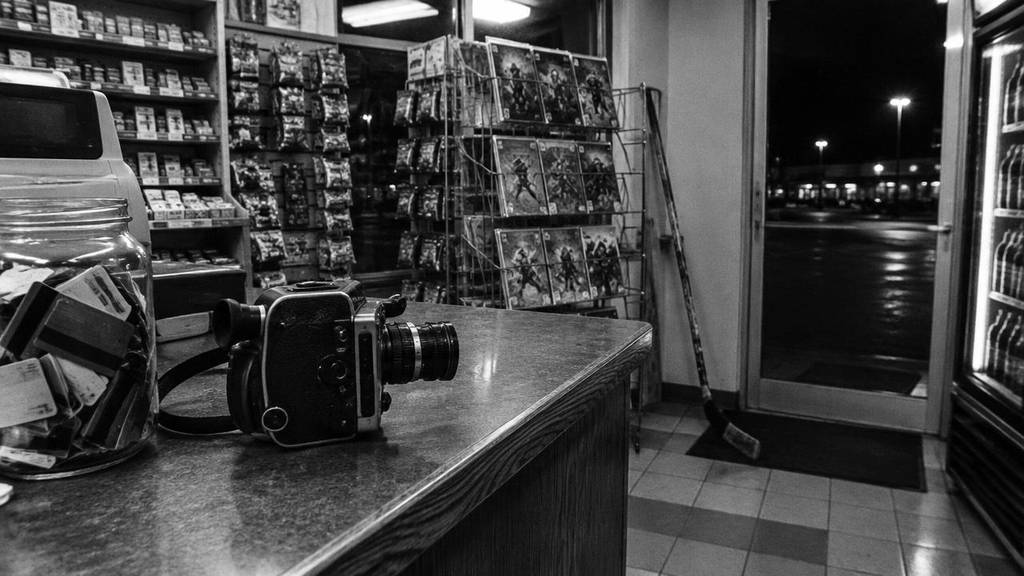
Clerks was shot in 1993 at the Quick Stop and the adjacent video store. Because the convenience store operated during the day, the production worked at night. The screenplay turned the closed shutters into part of the fictional situation, converting a practical restriction into an explanation inside the story. Black-and-white photography helped establish the film's look within its resources. Smith cast people from his circle, including Brian O'Halloran as Dante and Jeff Anderson as Randal, while playing Silent Bob himself. The movie's energy came from verbal collisions, grievances, friendship, and the feeling of being stuck at work when life seemed to be happening elsewhere.
The initial production cost is commonly reported at about $27,575, though later finishing and release expenses make that figure different from every eventual cost associated with the movie. Smith financed production through a mixture that included selling his comic-book collection, savings, and credit cards. Those details are memorable because they are precarious. Borrowed money did not make the script stronger or guarantee an audience. What it did was allow a narrowly designed production to happen. Clerks remains a useful case study in limiting what must be purchased, not a blanket endorsement of putting an untested feature on high-interest consumer debt.
The film screened at Sundance in 1994 and was acquired by Miramax. Its success made Smith a prominent figure in the independent-film wave of the period. The attention came partly from the mismatch between modest production surfaces and a highly identifiable voice: dense pop-culture arguments, explicit jokes, and characters turning small frustrations into grand debates. Distribution and publicity then helped bring that voice to people who would never have encountered a local screening. Smith's breakthrough therefore involved both making something specific and connecting it to an industry mechanism capable of reaching an audience. Completion alone was necessary, but it was not the entire journey.
Mallrats in 1995, Chasing Amy in 1997, and later projects expanded the interconnected fictional setting often called the View Askewniverse. Their differing receptions also made clear that one breakthrough did not eliminate uncertainty. Smith developed a broader relationship with audiences through appearances, podcasts, comics, and direct conversation. The enduring lesson of Clerks is precision about available advantages. He knew the workplace, could write its social rhythms, had access to its physical space, and built the production around those facts. His education was partly institutional and largely practical. The defining move was turning familiar limitations into a film with an unmistakable personality.
The Cheat Code: shortcuts that worked
1. Cheat Code: Inventory Access Before Plot
List locations you can genuinely control, then write a story whose best scenes belong there instead of treating access as a late production problem.
2. Cheat Code: Explain the Shutters Inside the Story
When a location restriction is unavoidable, look for a believable narrative consequence rather than trying to hide it with inadequate coverage.
3. Cheat Code: Make Workplace Talk Do Character Work
Use recurring arguments to reveal ambition, insecurity, loyalty, and resentment instead of writing banter that could belong to anyone.
4. Cheat Code: Separate the Famous Budget From Your Risk
Study Clerks' cost controls without romanticizing credit-card debt. Price finishing, sound, insurance, and distribution materials before committing money.
Your plan to do the same
- Secure written permission for one distinctive location you can use repeatedly.
- Record observations about its routines and social tensions without exposing private customer information.
- Write a short ensemble script whose conflict grows directly from that workplace.
- Turn location restrictions into story details wherever they improve credibility.
- Build a complete budget and financing ceiling that does not depend on festival success.
- Finish a short proof of concept, then use audience response and production records to assess a feature.
Frequently asked questions
Did Kevin Smith attend film school?
Yes, briefly. Smith attended Vancouver Film School in 1992 and left after roughly four months. He then directed his resources toward making Clerks. Describing him as a film-school dropout is accurate; describing him as someone who never received any formal filmmaking instruction would be misleading.
How did Kevin Smith pay for Clerks?
Smith financed Clerks through several sources, including savings, selling his comic-book collection, and credit cards. Its initial production budget is commonly reported at about $27,575. That figure should not be confused with every later finishing or release expense, and the debt involved was a genuine financial risk.
Was Clerks filmed in a real convenience store?
Yes. Clerks was filmed at the Quick Stop in Leonardo, New Jersey, where Smith worked, and at the adjacent video store. Shooting took place at night around the store's operating schedule. The closed shutters became part of the story, helping accommodate a practical location restriction.