
Design · Fashion designer and creative leader of Prada and Miu Miu
Miuccia Prada Made Contradiction Her Design Education
A political-science graduate entered the family accessories business and made supposedly wrong materials and awkward references central to luxury.
How did Miuccia Prada succeed?
Miuccia Prada succeeded by bringing an outsider's critical eye to an existing family business. Without formal fashion-school training, she developed products through materials, cultural references, and collaboration with Patrizio Bertelli. Nylon accessories, intellectually provocative collections, and distinct identities for Prada and Miu Miu turned unconventional taste into a powerful commercial language.
The story
Miuccia Prada was born in Milan in 1949 into the family behind a leather-goods business established by her grandfather Mario in 1913. Her preparation for a design career was conspicuously indirect. She completed a doctorate in political science, participated in left-wing politics, and trained in mime at Milan's Piccolo Teatro. These were real forms of education, just not fashion-school education. They placed questions about appearance, social roles, and cultural meaning alongside an interest in clothes. The tension between intellectual seriousness and an attraction to fashion did not disappear when she entered business; it became one of the productive complications of her work.
She took over the family business in 1978. Meeting leather-goods entrepreneur Patrizio Bertelli in the late 1970s created an important professional partnership that later became a marriage. Her design judgment and his manufacturing and commercial expertise helped transform a relatively small accessories house. This was not a startup without resources: the Prada name, existing products, and family infrastructure mattered. Neither was inheritance a complete explanation of the outcome. The challenge was to give the business a compelling new identity rather than simply preserve its old associations with respectable travel goods. Product decisions had to connect an unfamiliar aesthetic proposition with reliable making and distribution.
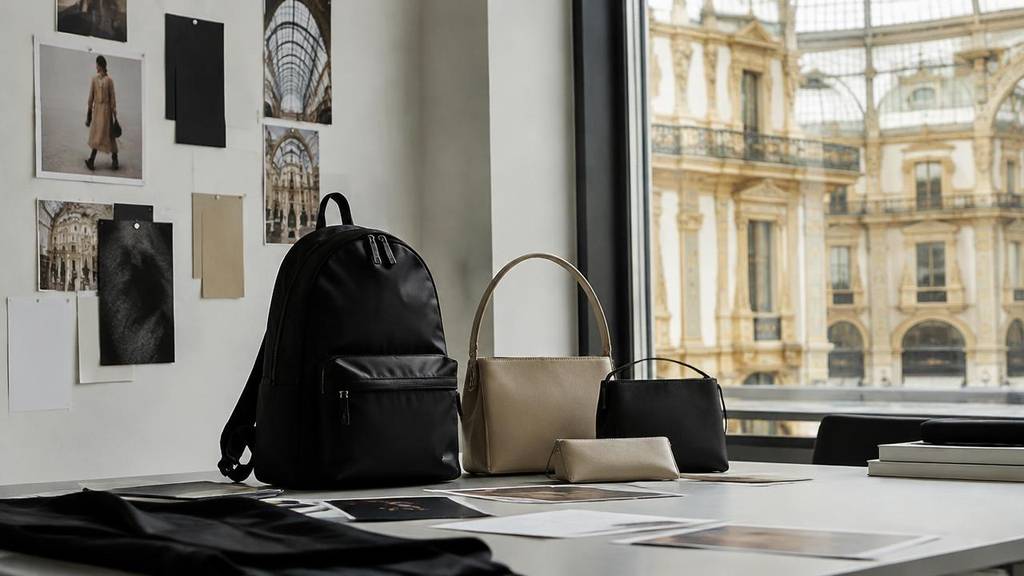
Black nylon accessories became the clearest early expression of that change. The backpack introduced in the 1980s, widely dated to 1984, challenged the expectation that luxury required visibly precious leather or ornamental hardware. Industrial-looking fabric could be desirable if proportion, finish, function, and context made it persuasive. Its commercial rise was not simply an instantaneous public surrender to a brilliant idea. The material's apparent plainness needed a market willing to recognize a different kind of distinction. Prada made that tension central: an object could look almost utilitarian while communicating considerable cultural and financial status to those who understood its positioning.
Her first womenswear collection was presented in 1988 for the following spring season. Rather than rely on spectacular eveningwear, she developed a vocabulary involving restrained shapes, uniforms, peculiar colors, modest references, and carefully placed disruptions. The work could be intellectually suggestive without becoming a literal illustration of an academic theory. In 1993, she launched Miu Miu, using her own nickname for a label with a different expressive register. Having two platforms allowed related but distinct investigations. Prada could sustain a more controlled institutional identity while Miu Miu offered room for another combination of youthfulness, awkwardness, sensuality, and experiment.
By the mid-1990s, collections associated with 'ugly chic' challenged prevailing assumptions about flattering color and conventional good taste. The point was not to select anything unattractive and call it advanced. Dissonant prints, dowdy references, synthetic surfaces, and unexpected combinations needed exact styling and proportion to become intentional. Cultural collaboration also widened the business's frame. Fondazione Prada, established in 1993, supported contemporary art, while architectural collaborations produced stores such as the Rem Koolhaas-designed New York Epicenter, opened in 2001. These undertakings positioned fashion within a larger cultural network, though their existence does not make every commercial product an intellectual achievement.
In 2020, Raf Simons joined Prada as co-creative director, formalizing a shared creative structure at the flagship label. The move made collaboration explicit in an industry that often prefers the myth of one sovereign designer. Miuccia Prada's career demonstrates how an education outside one's eventual field can sharpen the questions brought into it. Political science and performance did not teach pattern cutting by themselves; experienced teams, development work, manufacturing, and business organization remained essential. Her distinctive contribution was to keep testing the unstable boundary between attraction and resistance—asking why a material, color, or social reference was excluded from elegance, then constructing conditions in which that judgment could change.
The Cheat Code: shortcuts that worked
1. Cheat Code: Audit Your Own Bad Taste
Identify something you reject automatically, then investigate whether the reaction comes from material performance, social association, or habit.
2. Cheat Code: Upgrade the Context, Not the Preciousness
Use the nylon backpack to study how finish, proportion, distribution, and styling can reposition an ordinary-looking material.
3. Cheat Code: Make Contradictions Specific
Pair two clearly defined references, such as institutional uniform and eveningwear, instead of relying on vague claims of eclecticism.
4. Cheat Code: Give Different Ideas Different Platforms
Study Prada and Miu Miu as related but distinct identities, each with enough consistency to support its own experiments.
Your plan to do the same
- Write down five fashion conventions you accept without examining their origins.
- Research the class, labor, or cultural associations behind one supposedly inappropriate material.
- Prototype an accessory that improves that material through construction rather than ornamental disguise.
- Create a small collection around one explicit tension, such as severity versus sensuality.
- Collaborate with a technical specialist and record where their expertise changes your initial concept.
- Present the work with styling and context that make the intended contradiction intelligible.
Frequently asked questions
Did Miuccia Prada go to fashion school?
No. Miuccia Prada's formal education was in political science, and she also trained in mime. She developed her fashion practice within the family business through product work and collaboration. Her unconventional background informed her perspective, but manufacturing expertise and experienced creative teams were essential to realizing the designs.
Why was Prada's nylon backpack important?
The backpack made a practical, industrial-looking fabric central to a luxury product. Its significance came from the contrast between nylon's ordinary associations and the object's controlled design, finish, and positioning. It helped establish Prada's ability to make understatement and material contradiction desirable rather than relying on obvious preciousness.
What is the difference between Prada and Miu Miu?
Miu Miu, launched in 1993 and named after Miuccia Prada's nickname, is a separate label rather than simply a product line inside Prada. Both reflect her interests, but they support different creative identities. Miu Miu has often offered a more playful and irreverent register alongside Prada's controlled intellectual tensions.